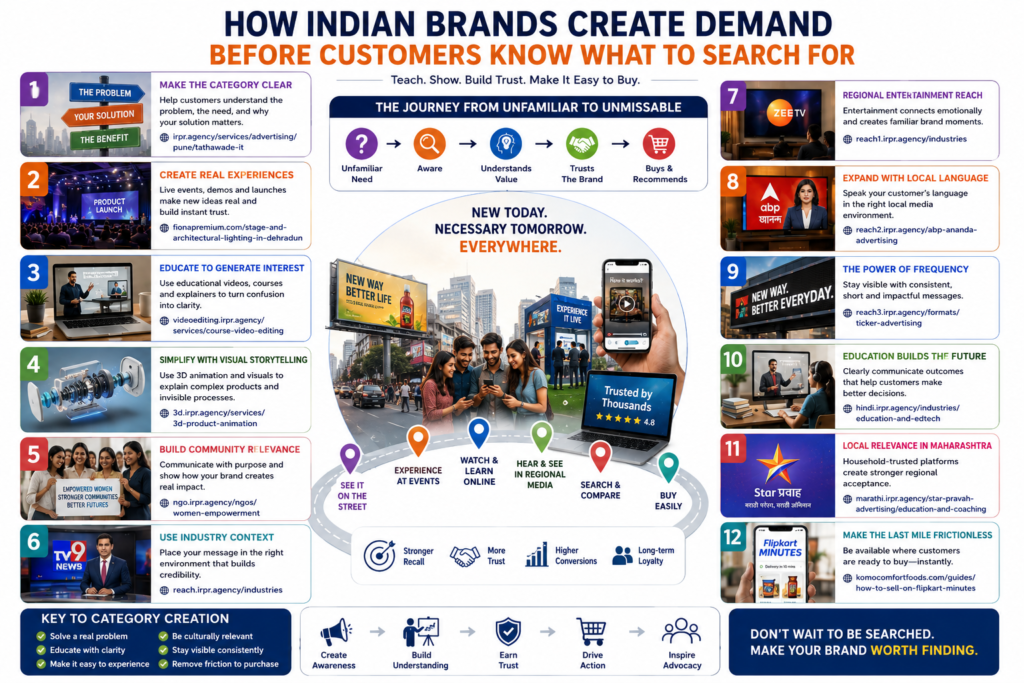
Some of the most difficult marketing challenges do not come from competition.
They come from unfamiliarity.
A business may have an excellent product, a useful service, a new technology, a better process, a healthier alternative, a premium offering or a genuinely different way of solving an everyday problem. But if customers do not understand the category yet, traditional advertising alone may not be enough.
People cannot search for something they do not know exists.
They cannot compare a solution they do not understand.
They cannot easily buy into a new idea if the brand has not first helped them see why the idea matters.
This is where category creation begins.
Category creation is not about making a product look complicated or pretending that every brand is revolutionary. It is about helping the market understand a need that may have been ignored, poorly served or explained in the wrong way.
A growing Indian brand may be introducing a new food format, a technology platform, a health service, a financial product, a premium retail concept, a manufacturing solution, an education model, a local service or a consumer product with a better use case. In every one of these situations, the business has to do more than create visibility.
It has to create understanding.
The brands that succeed are usually the ones that teach before they sell. They explain the problem before presenting the product. They make the unfamiliar feel familiar. They show customers how the offering fits into daily life, business operations, household decisions or long-term plans.
That is how a new product becomes an obvious choice.
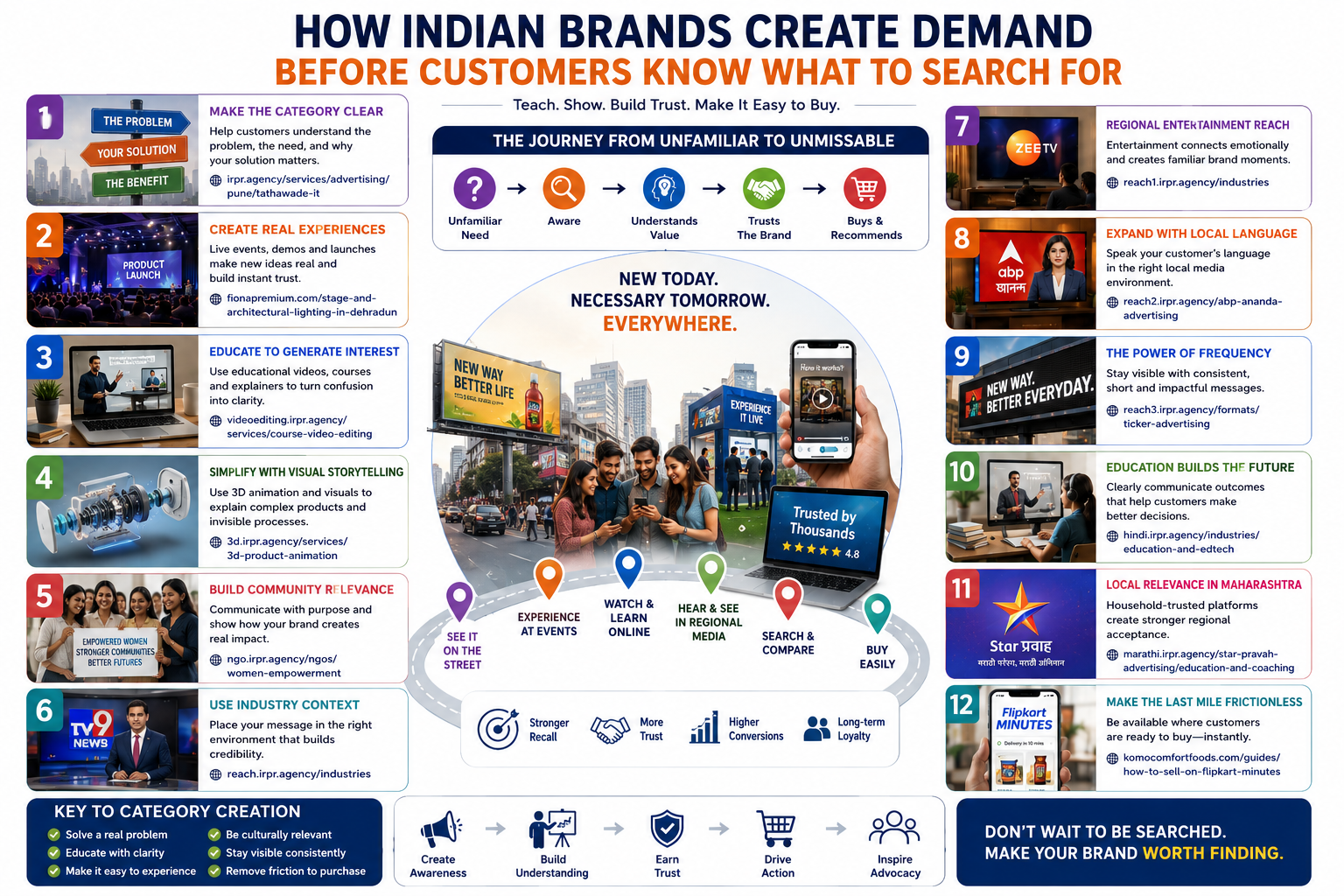
The First Job of Marketing Is to Make the Category Clear
When a product is new, customers often do not need more slogans.
They need a simpler explanation.
They need to know what the product is, why it exists, who it is for, what problem it solves and how it differs from the alternative they already use. If those answers are unclear, even a strong campaign can create curiosity without creating demand.
This is why businesses should not begin with the question, “How can we get more impressions?”
They should begin with the question, “What does the customer need to understand before they can care?”
For a new food brand, the answer may be an ingredient, a health benefit, a cooking convenience or a taste experience. For a SaaS product, it may be a simpler workflow, a cost-saving opportunity or a better way to manage a business process. For a wellness brand, it may be a daily routine that customers have not considered before. For an education business, it may be a clearer career outcome or learning model.
A strong local campaign is often built around this clarity. Businesses entering new business corridors, startup ecosystems and fast-growing professional markets can benefit from a city-aware advertising approach for technology and startup districts, where communication reflects not just the brand but also the environment in which customers are making decisions.
The point is not to make every message local for the sake of it.
The point is to make the message relevant enough that the audience understands why the offer belongs in their world.
Customers Believe What They Can Experience
A new category becomes easier to trust when people can see it in action.
This is why live experiences remain valuable even in a digital-first market. A customer may understand a product description online, but they often develop stronger confidence when they can see a demonstration, interact with the team, ask questions, hear an expert explain the idea or experience the brand in a physical setting.
For some businesses, this may mean a product launch. For others, it may mean a roadshow, pop-up, industry forum, retail preview, customer workshop, founder gathering, partner event or demonstration day.
The event environment itself matters because it shapes how seriously people take the experience. Stage design, lighting, presentation flow, guest movement, visual consistency and speaker visibility all affect whether the brand feels prepared.
Thoughtful stage and architectural lighting for corporate events may sound like a production detail, but it can significantly influence how a product story is received. When the room looks professional, speakers are clearly visible and the visual identity feels intentional, the audience is more likely to see the brand as credible.
A new market needs proof.
An event can provide that proof in a way that a static advertisement cannot.
The launch should not end when the event is over. It should generate product demonstrations, founder conversations, customer reactions, expert clips, visual assets and stories that can continue working long after the audience leaves.
Education Content Can Turn Uncertainty Into Interest
The most useful content for a new category is often not promotional content.
It is educational content.
A customer may not need to be told repeatedly that a product is the best. They may need help understanding the problem it solves. They may need to see examples, use cases, routines, comparisons and practical outcomes.
This is especially true in categories involving technology, professional services, healthcare, education, finance, manufacturing, home improvement, food innovation, beauty, wellness and B2B products.
Course-style content, structured explainers, expert modules, product walkthroughs and educational series can help businesses make unfamiliar ideas easier to understand. A professional course video editing workflow can turn raw training footage, founder sessions, expert interviews, demonstrations and learning modules into useful content that audiences can actually follow.
A strong educational video does not try to explain every possible feature.
It gives the viewer one clear step forward.
It may answer a question such as: What is this? Who needs it? What does it replace? How does it work? What happens after someone signs up, buys, books or enquires?
That clarity is powerful because it lowers the risk of trying something new.
When customers feel informed, they are more willing to continue the conversation.
Visual Storytelling Makes Difficult Ideas Easier to Remember
Some products are hard to explain because they are technical.
Others are difficult because they are invisible.
A software platform may improve an internal workflow that cannot be photographed. A machine may have important components inside it. A new property or retail space may still be under construction. A healthcare solution may involve a process that people find intimidating. A food or consumer product may need to demonstrate ingredients, benefits or usage situations that a simple packshot cannot communicate.
This is where visual storytelling can do more than make a campaign look polished.
It can make the offer easier to understand.
A detailed 3D product animation and visualisation service can help brands show the parts of a product, process or customer experience that ordinary photography cannot capture.
A product can be shown from every angle. A manufacturing process can be simplified. A future space can be visualised before construction. A complex mechanism can be made understandable. A new consumer product can be shown in a more compelling setting than a plain catalogue image.
The goal is not visual effects for their own sake.
The goal is comprehension.
People are more likely to consider something new when they can imagine how it works in real life.
Community Relevance Gives New Brands a Stronger Foundation
A new brand can create demand through advertising, but it builds deeper trust when it also understands the communities it wants to serve.
This does not mean every company needs to run a charity campaign. It means brands should recognise that customers care about more than product features. They also care about fairness, opportunity, representation, access, local relevance and the values behind the company.
For example, a financial brand may support women entrepreneurs. A consumer brand may invest in local employment. A technology company may create skill-development initiatives. A wellness business may support accessible health education. A retail company may partner with community organisations that make its purpose more meaningful.
The storytelling principles used in women empowerment campaigns are useful for commercial brands as well. The strongest communication focuses on agency, progress, participation and real outcomes rather than emotional exploitation.
Customers are more likely to trust a brand when it shows respect for the people it speaks to.
Purpose cannot be added at the end of a campaign as a decorative line.
It has to be visible in the way a company behaves, communicates and contributes.
Industry Context Helps Customers Take Brands Seriously
The same advertisement will not work equally well for every category.
A consumer brand, healthcare provider, education business, manufacturing company, finance platform, real-estate developer and technology startup all have different buyer journeys.
They need different proof.
They need different media environments.
They need different explanations.
This is why category-specific planning matters. A business should not only ask where its audience is spending time. It should ask what kind of environment will make the message feel more relevant.
An industry-led TV9 advertising strategy can help brands think about campaign planning through the lens of their category rather than relying on generic media buying.
A healthcare business may need public-awareness content and expert voices. A real-estate company may need regional credibility and lead generation. A consumer brand may need repeated household visibility. An education company may need trust from students and parents. A B2B company may need an environment that signals authority.
The best campaign does not simply reach the audience.
It appears in a context that helps the audience believe the message.
Regional Entertainment Can Make a New Category Feel Familiar
When customers do not understand a category yet, familiarity becomes extremely valuable.
People may not immediately trust a new product, but they begin to remember it when they see it repeatedly in environments they already enjoy. Entertainment media can create that kind of familiarity because the audience is relaxed, engaged and often sharing the experience with others at home.
For consumer brands, education companies, family services, wellness products, local retailers and household categories, a category-fit Zee advertising plan by industry can help determine where different types of products are most likely to feel relevant.
A product that needs family acceptance may benefit from entertainment-led media.
A service that needs authority may benefit from business or news-led contexts.
A regional product may benefit from local-language programming.
A digital-first brand may need a mix of television visibility, streaming reach and performance-driven follow-up.
The important part is not simply running more advertisements.
It is giving the audience enough repeated exposure that the unfamiliar starts feeling known.
Language Expansion Should Be Built Around Real Market Behaviour
India’s language markets are not just translation markets.
They are different cultural and commercial environments.
A brand expanding into West Bengal, Maharashtra, Karnataka, Uttar Pradesh, Telangana, Tamil Nadu, Punjab or Gujarat cannot assume that one creative idea will automatically create the same response everywhere.
The brand may have one central promise, but the customer context changes.
The media habits change.
The price sensitivity changes.
The role of family changes.
The kind of proof people need can change.
For a business exploring eastern India, a regional ABP Ananda advertising approach can provide a route into Bengali-language news audiences and local market conversations.
The real value of regional communication is not simply that it reaches a language group.
It is that the brand becomes easier to understand in the environment where the customer already lives, works, watches and decides.
A market-entry campaign should feel like it belongs in that market.
That is how a new category begins to travel beyond its original city.
Frequency Is Often More Important Than One Big Message
Many businesses put all their energy into one launch campaign.
They create one film, one event, one media placement and one burst of activity. Then they wait for results.
But new categories rarely grow through one moment.
They grow through repetition.
A customer may need to see the same brand several times before remembering it. They may need to understand one aspect of the product first, then another. They may need to hear the brand name in a trusted context, see it again on social media and later notice it when they are ready to purchase.
This is why smaller but repeated media formats can be useful.
A focused ticker advertising format can help create recurring visibility around a clear message without requiring every campaign to depend on a full-length commercial.
For a new category, the message should remain simple.
A product is now available.
A service solves a specific problem.
A brand is entering a city.
A new offer is relevant for a particular customer group.
A founder or expert has a useful perspective.
The message should not change every week.
The brand needs time to earn memory.
Education Brands Offer a Useful Lesson for Every Industry
Education businesses understand something that many brands forget.
Before people make a decision, they need to understand the outcome.
Students need to know how a course may help them. Parents need to feel confident about quality and safety. Professionals need to see how a learning program connects to their future. The same principle applies across almost every category.
A buyer wants to understand what changes after they choose the brand.
For Hindi-speaking markets, education and edtech advertising shows how communication can be built around clarity, trust, aspiration and practical decision-making.
A product does not always need to promise transformation in dramatic language.
It needs to help people see the value of taking the next step.
This may be a better career decision, a healthier routine, a more efficient business process, a more convenient household choice, a safer financial option or a product that simply makes daily life better.
When customers can clearly visualise the outcome, they become easier to convert.
Maharashtra Requires Household-Level Relevance
Maharashtra is a major market for consumer brands, education businesses, healthcare providers, retailers, financial services and technology companies.
But it should not be treated as one single audience.
Mumbai, Pune, Nashik, Nagpur, Kolhapur, Thane, Navi Mumbai and Chhatrapati Sambhajinagar all have different customer habits, local influences and decision-making patterns.
For education and coaching brands, a targeted Star Pravah education and coaching advertising approach can help build household-level familiarity through Marathi-language media.
The broader lesson applies to every category.
A local-language campaign works best when it feels natural to the audience.
It should not sound copied from an English advertisement.
It should use familiar situations, relatable aspirations, practical benefits and emotional cues that make sense in the local market.
When the brand communicates naturally, it becomes easier for people to invite it into their home, their routine or their decision-making process.
The Product Must Be Ready When Curiosity Turns Into Purchase
Creating category awareness is only half the job.
The other half is making sure the product is easy to buy when the customer is finally ready.
This is especially important for FMCG, food, beauty, personal care, household, wellness and D2C brands.
A customer may first hear about the brand through a campaign, event, video, local-language advertisement or founder story. They may then search for it on a quick-commerce platform and expect the product to be available immediately.
At that stage, the product page becomes the final decision point.
The image must be clear.
The pack size must be understandable.
The title must make sense quickly.
The product benefit must be visible.
The offer must be easy to evaluate.
The product needs to be available in the customer’s city.
A practical guide on how FMCG brands can sell through Flipkart Minutes can help brands think about the final shelf where brand discovery becomes an actual order.
A great campaign creates interest.
A clear listing converts that interest.
A strong category-creation strategy must connect both.
Final Thoughts
The brands that create demand do not wait for customers to know exactly what to search for.
They shape the search.
They introduce the problem, explain the opportunity, make the product easy to understand and create enough familiarity that the category feels natural by the time the customer is ready to choose.
They use events to make the idea real.
They use educational content to reduce confusion.
They use visual storytelling to make complex things simple.
They use community relevance to build trust.
They use regional media to enter markets naturally.
They use language to create emotional familiarity.
They use frequency to build memory.
They use quick commerce, marketplaces and digital storefronts to make the final action easy.
That is how a new product becomes a known option.
And that is how a known option becomes a category leader.