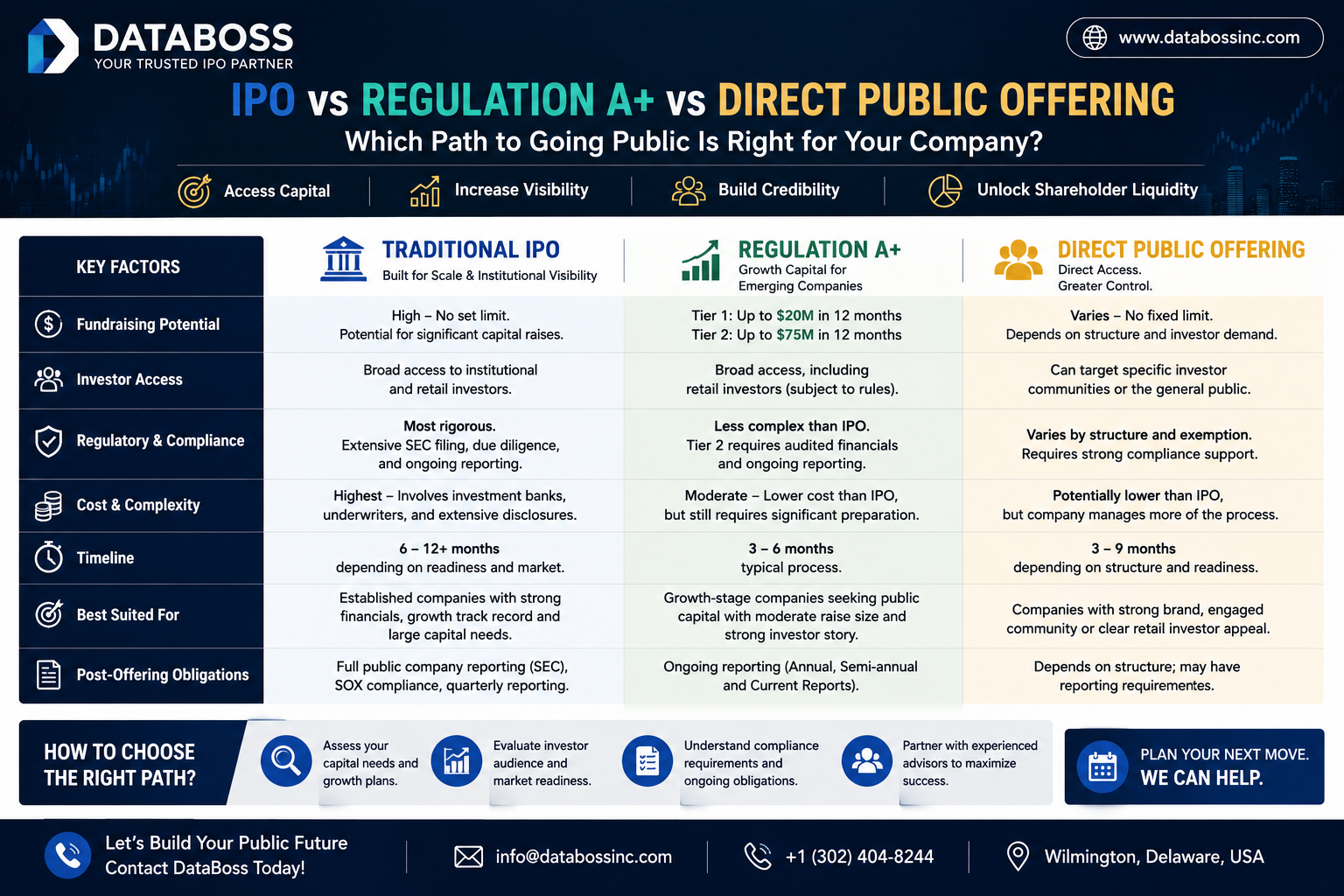
Taking a company public can create access to capital, improve market visibility and give early shareholders a potential liquidity pathway. However, there is no single route that fits every business.
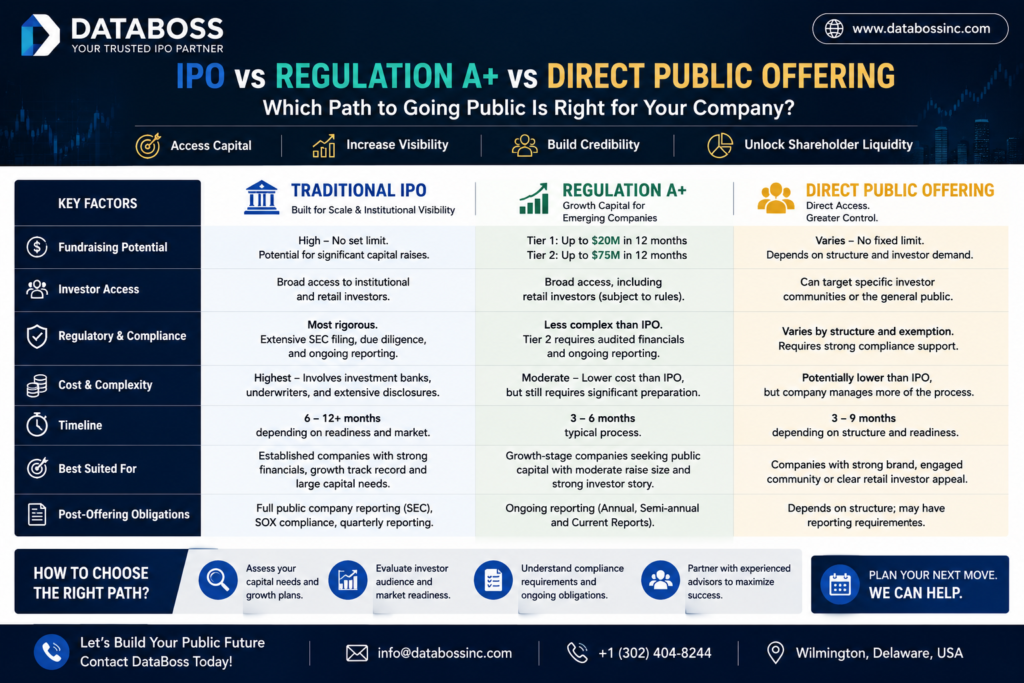
A traditional IPO, a Regulation A+ offering and a direct public offering can all help a company reach public investors, but they differ significantly in fundraising potential, investor access, regulatory workload, cost structure and the level of market readiness required.
For founders, executives and boards, the real question is not simply how to take a company public. It is which route aligns with the company’s stage, capital requirement, investor story, governance maturity and long-term growth strategy.
Traditional IPO: Built for Larger Capital Raises and Institutional Visibility
A traditional initial public offering is the route most people associate with “going public.” It generally involves a registered offering, investment-bank participation, institutional marketing, due diligence, detailed disclosure and a planned listing process.
A traditional IPO can be appropriate for companies with established revenue, meaningful growth potential, credible financial controls, experienced management and a business story that can attract institutional as well as retail investor interest.
The main advantage is scale. A strong IPO may provide access to a broad investor base, major-market visibility and a clearer path toward exchange listing. It can also strengthen the company’s brand with customers, partners, employees and future investors.
However, this route demands substantial preparation. Companies should expect extensive financial reporting, legal review, governance work, investor-relations planning and ongoing public-company responsibilities after the transaction closes.
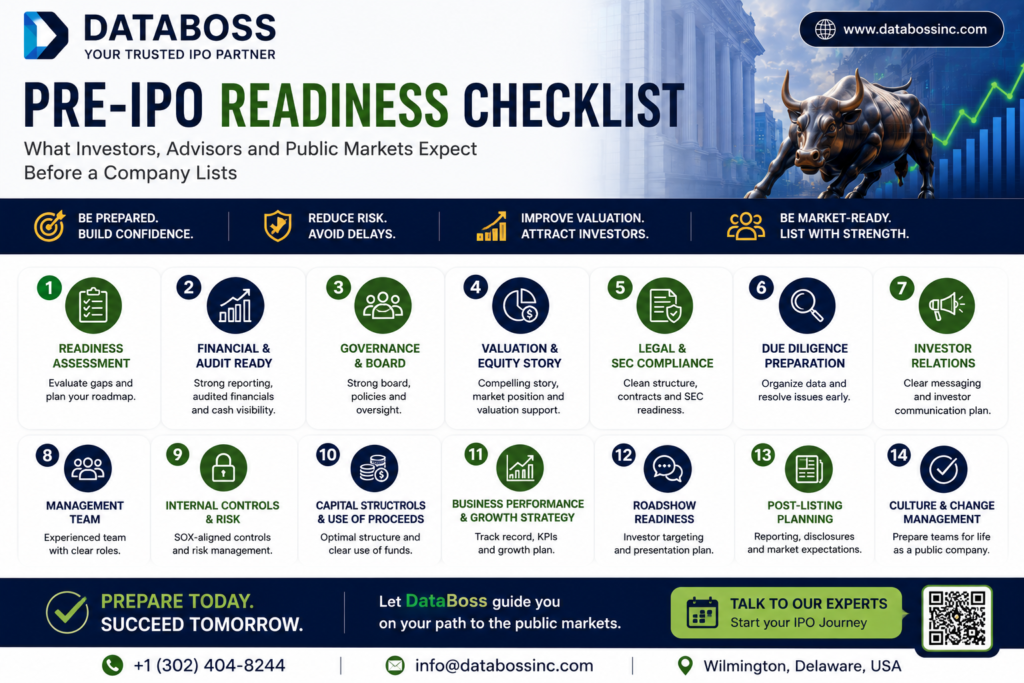
Businesses considering this route should first assess their readiness for a traditional IPO strategy, including documentation, regulatory preparation, valuation positioning and investor-market expectations.
Regulation A+: A Public Capital-Raising Route for Emerging Growth Companies
Regulation A+, formally known as Regulation A, can provide a more accessible public-offering framework for certain companies that may not yet be ready for a full traditional IPO.
Under current U.S. Securities and Exchange Commission rules, Tier 1 offerings can raise up to $20 million in a 12-month period, while Tier 2 offerings can raise up to $75 million in a 12-month period. This makes Regulation A+ particularly relevant for growth-stage businesses seeking public capital without pursuing the same scale of offering typically associated with a larger traditional IPO.
Regulation A+ can allow companies to market to a broad audience, including retail investors, subject to the applicable rules and offering structure. This can be valuable for consumer-facing brands, technology companies, mission-driven businesses, innovative product companies and organisations with an engaged customer community.
However, it should not be treated as an easy shortcut. A successful Regulation A+ offering still requires a strong business case, investor-ready disclosures, audited financial statements for Tier 2 offerings, appropriate compliance planning and a practical investor-acquisition strategy.
Companies evaluating this route can explore a Regulation A+ offering framework to determine whether their funding target, corporate structure and investor audience are suitable.
Direct Public Offering: More Direct Access, More Responsibility
A direct public offering, or DPO, generally refers to a company offering securities directly to investors rather than relying on a traditional underwritten IPO process.
It is important to understand that a DPO is not always one single legal exemption or one standard transaction structure. The company may use a particular securities-registration or exemption pathway depending on its circumstances, target investors and capital-raising objectives.
The potential advantage of a DPO is greater direct control. The company may communicate more directly with its investor community, customers, supporters or strategic audience. It may also reduce reliance on the conventional underwriter-led model.
The trade-off is that the company must be prepared to manage more of the investor-engagement process. It needs a credible offering narrative, strong compliance support, clear investor materials, financial readiness and a realistic plan for building demand.
A DPO can be especially relevant for businesses with an existing community, a differentiated brand, customer loyalty or a clear reason why retail investors may want to participate in the company’s growth.
For companies assessing this route, direct public offering advisory support can help clarify the structure, readiness requirements and strategic considerations before a formal transaction process begins.
IPO vs Regulation A+ vs DPO: Key Differences
The best route depends on the company’s goals, not on which option sounds most prestigious.
A traditional IPO is generally best suited to companies aiming for substantial capital raises, institutional participation and a major-market profile. It often requires the highest level of corporate maturity, financial preparation and compliance readiness.
Regulation A+ may suit companies seeking a more accessible public-capital route, particularly when retail-investor participation and community-based investor outreach are important. It can offer meaningful fundraising potential, but it still requires serious disclosure, compliance and marketing preparation.
A direct public offering may work best for a company with a clear investor community and a desire for more direct engagement. It can offer flexibility, but the company must be capable of creating awareness, explaining its opportunity and managing investor communications responsibly.
Comparing Fundraising Potential
Fundraising potential is one of the first considerations when choosing a path to going public.
A traditional IPO can support larger fundraising ambitions because it may involve institutional investors, underwriting support and broader capital-market participation. The possible size of a traditional IPO depends on market conditions, company fundamentals, valuation, investor demand and listing requirements.
Regulation A+ has clearer statutory offering limits. Tier 1 allows offerings up to $20 million in a 12-month period, while Tier 2 can allow offerings up to $75 million during the same period.
A direct public offering can vary widely because the legal structure behind the offering may differ. The fundraising potential depends on the chosen securities-law pathway, investor demand, the company’s disclosures and how effectively the offering is marketed.
Companies should begin by calculating the actual capital required. A business seeking growth capital for product development, market expansion and team building may need a very different route from a company preparing for national expansion, acquisitions or major infrastructure investment.
Investor Access and Market Reach
A traditional IPO usually provides the strongest route to institutional-market visibility. Investment banks, research coverage, roadshows and exchange-listing expectations can help companies reach professional investors, funds and larger market participants.
Regulation A+ can offer access to a wider mix of retail and accredited investors. This can be particularly useful for companies that want customers, advocates and community supporters to participate in their growth story.
A DPO can be highly effective when the company already has direct audience access. This could include a customer base, professional network, user community, industry following or brand-led investor audience.
However, access to investors does not automatically create demand. Every route requires a credible valuation, transparent disclosures, a differentiated story and disciplined investor communication.
Compliance Workload and Disclosure Requirements
All going-public paths involve legal, financial and regulatory responsibilities. The difference lies in the depth, timing and ongoing nature of those obligations.
A traditional IPO typically requires detailed registration disclosures, audited financials, legal review, governance preparation and continuing reporting obligations once public.
Regulation A+ also requires meaningful disclosure. Tier 2 offerings require audited financial statements and ongoing reporting requirements after qualification. Tier 1 offerings may involve different state-level review requirements, depending on the structure and jurisdiction.
A DPO can never be approached casually. The company still needs to comply with the legal route selected, ensure that its investor communications are accurate and complete, and prepare appropriate offering documentation.
This is why legal counsel, auditors, financial advisors and U.S. going public advisory specialists should be involved early. Compliance should be integrated into the company’s plan, not added at the end.
Timelines and Cost Considerations
There is no universal timeline or fixed cost for a public offering. The process depends on the company’s readiness, financial history, audit status, governance structure, complexity of the business, quality of records, legal matters and investor-market conditions.
A traditional IPO can involve a longer preparation period because companies often need to strengthen reporting systems, finalise audits, prepare registration materials, engage advisors, complete due diligence and conduct investor marketing.
Regulation A+ may be more practical for some emerging companies, but it still requires careful preparation, SEC qualification processes, financial documentation and an investor-marketing strategy.
A DPO may reduce certain elements of a conventional underwriting process, but the company may need to take on more responsibility for investor education, outreach and demand generation.
The correct approach is to assess total readiness cost, not only filing cost. Companies should budget for audits, legal work, accounting support, compliance, investor relations, technology, marketing materials, communication infrastructure and post-offering reporting.
Post-Listing and Post-Offering Responsibilities
Going public is not a one-time event. It creates an ongoing obligation to communicate responsibly with shareholders and the market.
Public companies may need to manage periodic reporting, financial disclosures, investor questions, shareholder engagement, governance requirements, market announcements and compliance deadlines. Management teams must be prepared for the additional time and discipline required after capital is raised.
Investor confidence depends on clear, consistent and credible communication. Companies should have a plan for earnings updates, investor presentations, press releases, corporate announcements, crisis-response communication and shareholder accessibility before the offering begins.
A structured U.S. investor-relations communication strategy can help public and pre-public companies present their story clearly, support shareholder engagement and build trust through transparent financial messaging.
Which Company Profile Fits Each Route?
A traditional IPO may be appropriate for a company with established traction, scalable operations, mature governance, significant capital needs and strong institutional appeal.
Regulation A+ may be suitable for a growth-stage company with a compelling public-facing story, a realistic funding target, solid financial preparation and the ability to reach both retail and accredited investors.
A direct public offering may be relevant for a company with strong customer loyalty, a clear investor community, direct marketing capability and a desire to retain greater control over how the opportunity is presented.
No route is automatically better. The strongest choice is the one that matches the business model, capital need, investor audience, corporate maturity and post-offering capacity.
Why DataBoss Should Be Part of the Evaluation Process
Choosing between an IPO, Regulation A+ offering and direct public offering involves more than selecting a transaction label. It requires a realistic assessment of corporate readiness, capital needs, compliance obligations, investor demand and long-term market strategy.
DataBoss can help companies evaluate the available routes, identify readiness gaps and build a strategic path toward public-market participation. The right advisory process can help management teams avoid pursuing an unsuitable structure, improve their investor narrative and prepare for the operational responsibilities that follow a successful offering.
Conclusion
The decision between a traditional IPO, Regulation A+ and a direct public offering should be based on business reality, not ambition alone.
A traditional IPO can offer scale and institutional visibility. Regulation A+ can provide a structured public-capital path for eligible growth companies. A DPO can give businesses more direct investor access and greater control over engagement.
Before moving forward, companies should assess their funding target, investor profile, compliance readiness, financial reporting, governance capacity and post-offering responsibilities. With the right preparation and strategic advisory support, going public can become a disciplined growth decision rather than an uncertain leap.