Taking a company public is not simply a financing event. It is a major operational transition that changes how a business reports financial performance, manages governance, communicates with investors and responds to regulatory expectations.
A successful listing requires far more than revenue growth or an attractive business idea. Investors, advisors, underwriters and public markets want to see a company that is financially disciplined, legally prepared, well governed and able to communicate its story with consistency.
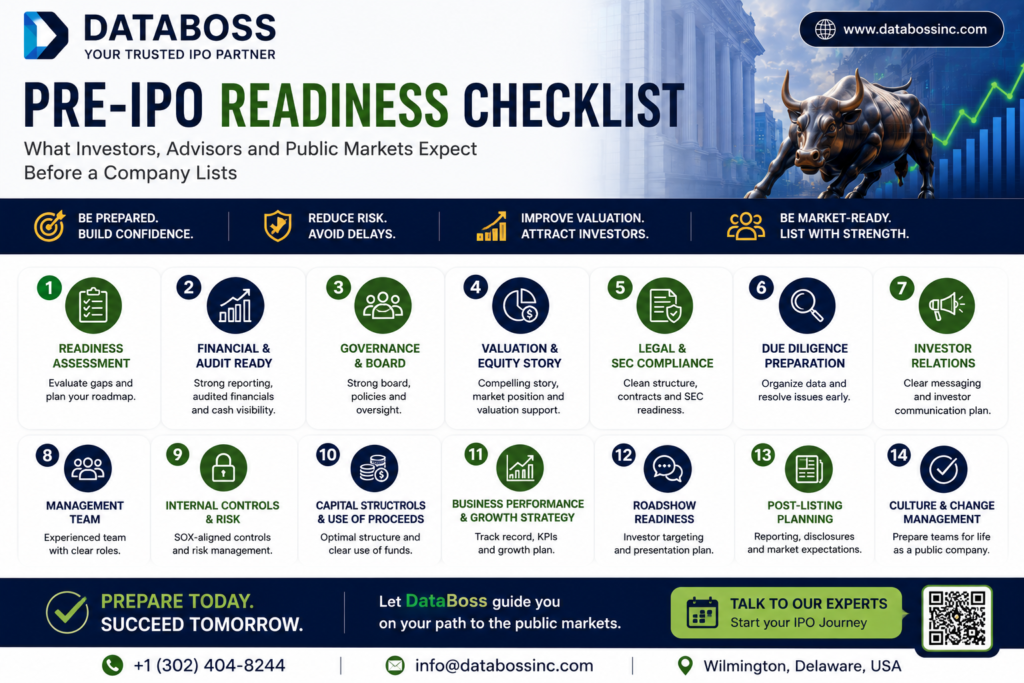
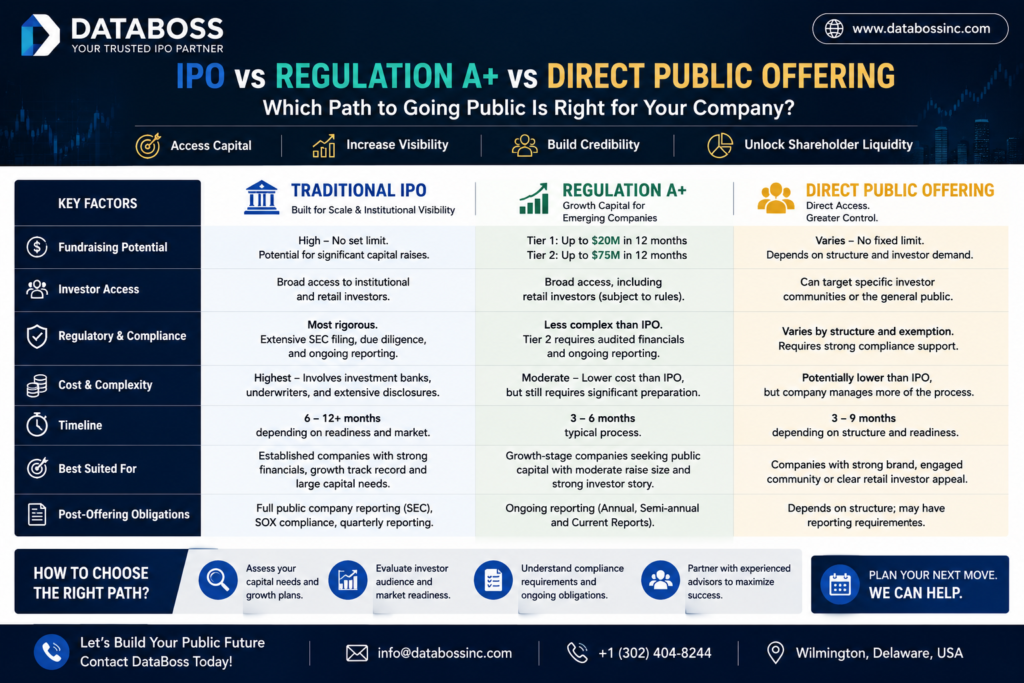
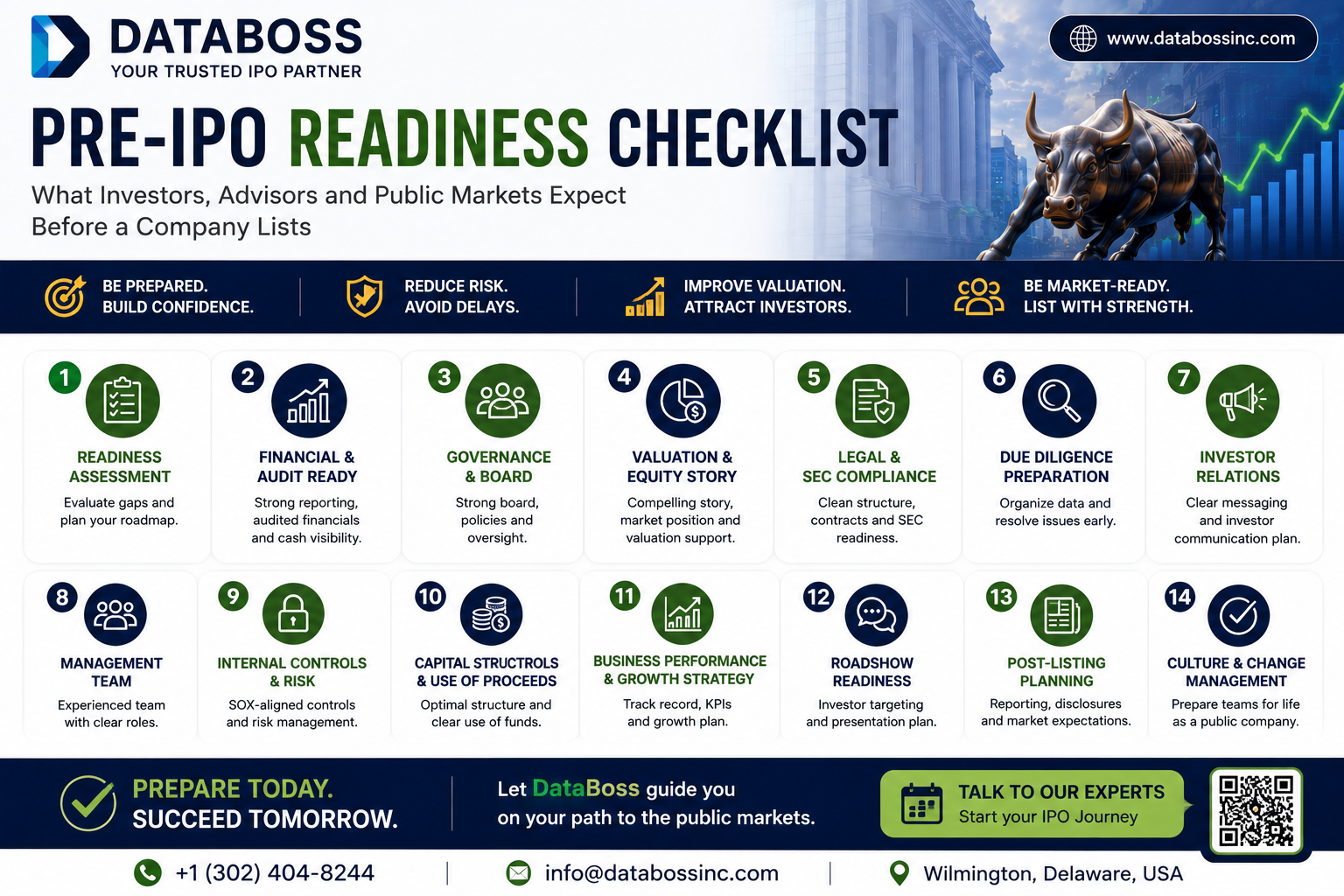
This pre IPO checklist outlines the core workstreams companies should address before pursuing an IPO, direct listing, Regulation A+ offering or another public-market route.
Important note: This guide is for general business education and should not be treated as legal, accounting, investment or securities advice. Companies should work with qualified securities counsel, auditors, accountants and advisors for transaction-specific decisions.
1. Complete an IPO Readiness Assessment First
An IPO readiness assessment is the starting point for any serious public-market strategy. It helps management identify the gap between the company’s current operating model and the standards expected of a public issuer.
The goal is to answer practical questions early:
- Are the company’s financial records complete and audit-ready?
- Can management produce reliable reporting on a predictable schedule?
- Is the board structured appropriately for public-company oversight?
- Are legal records, contracts and intellectual-property rights properly documented?
- Does the company have a clear investor story?
- Are internal controls strong enough to support public reporting?
- Is the business ready for the scrutiny of analysts, investors and regulators?
Many companies delay this assessment because they are focused on growth. That can create avoidable problems later. A readiness review makes it easier to prioritise the gaps that must be resolved before a formal filing or investor-marketing process begins.
2. Strengthen Financial Reporting and Audit Readiness
Public investors need reliable financial information. That means a company must be able to present historical performance, explain its financial position and support its numbers with clear documentation.
Before an IPO, management should review whether it has:
- Timely monthly, quarterly and annual financial reporting
- Accurate revenue-recognition practices
- Documented accounting policies
- Complete supporting schedules and reconciliations
- Audited financial statements where required
- Reliable budgeting and forecasting systems
- Clear visibility into cash flow, debt, working capital and capital expenditure
- A finance team capable of working with auditors, counsel and underwriters
Financial readiness is not only about passing an audit. Investors want to understand the quality of revenue, customer concentration, gross-margin drivers, unit economics, debt profile, cash needs and path to profitability.
A thorough IPO financial due diligence process can help companies identify reporting gaps, assess risk areas and prepare financial information for deeper review by advisors and potential investors.
3. Establish Public-Company Governance Standards
Governance becomes much more visible once a company enters public markets. Investors evaluate not only the business model, but also the quality of leadership, oversight and decision-making.
A pre-IPO company should review its board structure, committee responsibilities, executive accountability and risk-management processes.
Key governance considerations include:
- A board with relevant financial, industry and public-company experience
- Defined audit, compensation and governance committee responsibilities
- Clear approval processes for major decisions
- Policies covering related-party transactions
- Insider-trading and disclosure-control policies
- Documented risk-management procedures
- Executive compensation arrangements that can be explained clearly
- Succession planning for key leadership roles
Strong governance signals that management is prepared to operate with greater transparency and accountability. It also gives investors more confidence that the company can manage growth, market pressure and shareholder expectations responsibly.
4. Build a Defensible Valuation and Equity Story
Valuation is not just a number. It is the market’s view of the company’s growth potential, financial quality, competitive position and future risks.
Before listing, management should be able to explain why the company deserves investor attention. This is often called the equity story.
A strong equity story should answer:
- What problem does the company solve?
- What makes the business differentiated?
- How large is the market opportunity?
- What evidence supports future growth?
- How does the company make money?
- What protects its position from competitors?
- What are the major risks?
- How will new capital be used?
- What milestones can investors reasonably expect after listing?
The best investor narratives are specific and evidence-based. Avoid broad claims such as “disruptive,” “high growth” or “market-leading” unless the company can support them with credible data, customer proof, market analysis or financial performance.
A public-company story must also remain consistent across the prospectus, investor presentation, management discussions, roadshow materials and post-listing communications.
5. Prepare Legal Records and SEC Compliance for an IPO
Legal and regulatory preparation often becomes one of the most detailed parts of the IPO journey. Companies need to ensure that corporate records, material agreements, disclosures and risk factors are complete, accurate and internally consistent.
The exact filing and disclosure obligations depend on the company, the proposed offering path, its jurisdiction, listing target and legal structure. However, companies should expect securities counsel and advisors to review areas such as:
- Corporate formation and ownership records
- Subsidiary structure and shareholder agreements
- Material customer, supplier and partnership contracts
- Intellectual-property ownership and licences
- Employment agreements and equity-compensation plans
- Pending or potential litigation
- Data-protection, privacy and cybersecurity obligations
- Industry-specific licences and regulatory approvals
- Risk factors and forward-looking statements
- Related-party transactions and governance disclosures
A regulatory compliance and SEC-readiness review can help management organise these workstreams before the transaction process becomes time-sensitive.
The objective is not to eliminate every risk. It is to identify material risks, document them properly and ensure that the company’s disclosures are clear, complete and not misleading.
6. Organise Due Diligence Before Outside Review Begins
Due diligence is where a company’s story is tested. Investors, underwriters, auditors and legal advisors may review financial, legal, commercial, operational and governance information in detail.
Businesses should prepare a secure, well-structured data room before the process intensifies. Documents should be current, version-controlled and easy to locate.
A pre-IPO due-diligence package may include:
- Audited and management financial statements
- Tax filings and debt documentation
- Customer and supplier agreements
- Cap table and shareholder records
- Board minutes and governance policies
- Intellectual-property registrations and licences
- Employment and incentive agreements
- Product, market and competitive-analysis materials
- Regulatory approvals and compliance records
- Insurance coverage and claims history
- Litigation disclosures and legal opinions where required
- Risk-management reports and cybersecurity policies
Incomplete documentation can slow a transaction, reduce investor confidence and create difficult questions later. A well-prepared data room signals that management understands the level of discipline required in public markets.
7. Plan Investor Relations Before the IPO, Not After It
Investor relations before IPO is one of the most overlooked areas of readiness. Many management teams focus heavily on raising capital but do not prepare for the communication responsibilities that follow.
Once a company enters public markets, shareholders, analysts, journalists and prospective investors may all expect clear, timely and consistent information.
Before listing, the company should develop:
- A clear investor presentation
- Core messaging and management talking points
- A financial-calendar framework
- Earnings and milestone communication processes
- Investor FAQ documents
- Media and analyst response protocols
- A shareholder-engagement approach
- Crisis-communication procedures
- Guidelines for executive public statements
- A process for coordinating finance, legal, communications and leadership teams
A thoughtful pre-IPO investor-relations strategy can help leadership teams build trust before the roadshow and maintain more disciplined communication after listing.
Strong investor relations does not mean promoting the company aggressively. It means explaining performance, strategy, risks and future priorities with credibility.
8. Prepare the Roadshow Story and Management Team
The roadshow is not simply a presentation. It is a test of the company’s leadership, confidence, clarity and ability to answer difficult questions.
Investors will often assess how well the CEO, CFO and senior leadership understand the business, market conditions, risks, financial model and growth plan.
Management should prepare for questions around:
- Revenue growth and customer retention
- Margins and pricing power
- Cash flow and capital requirements
- Competitive threats
- Market size and demand assumptions
- Customer concentration
- Regulation and compliance risks
- Technology, operational or supply-chain risk
- Use of proceeds
- Path to profitability or scale
- Key performance indicators
- Post-listing priorities
Roadshow planning should include message testing, presentation preparation, Q&A rehearsals, investor-targeting strategy and clear coordination between advisors, finance, legal and communications teams.
The best roadshow teams do not memorise scripted answers. They understand the company’s numbers, risks and long-term strategy deeply enough to speak with clarity under pressure.
9. Build the Right Internal Control Environment
Public companies are expected to maintain reliable reporting and disclosure systems. This requires more than a capable finance department.
Management should evaluate internal controls related to financial reporting, revenue recognition, purchasing, expense approvals, access to systems, data security, related-party transactions, cash management and executive disclosure.
The company should also define who is authorised to approve information before it is released publicly. Financial communications, press releases, investor presentations and market-sensitive statements should go through an organised review process involving appropriate leadership, legal and finance stakeholders.
A strong control environment reduces the risk of inconsistent disclosures, delayed reporting and preventable compliance issues.
10. Plan for Life as a Public Company
The IPO may be the headline event, but the real work begins after the listing.
Public-company responsibilities can include recurring reporting, shareholder communication, governance meetings, earnings preparation, market disclosures, regulatory deadlines and continued investor engagement.
Companies should prepare a post-listing operating plan that covers:
- Quarterly and annual reporting calendar
- Earnings-release process
- Investor presentation updates
- Analyst and shareholder communication
- Board and committee meeting schedule
- Material-event disclosure controls
- Media-response procedures
- Crisis and reputation-management planning
- Shareholder-query management
- Ongoing compliance monitoring
A company that is well prepared for the first day of trading but unprepared for the first earnings cycle can lose credibility quickly. Public-market readiness must include the systems, people and communication processes required for long-term execution.
11. Common Pre-IPO Mistakes to Avoid
Many companies delay their IPO because early preparation was incomplete. The most common mistakes include:
- Treating financial reporting as an audit-only exercise
- Waiting too long to strengthen the board and governance structure
- Using inconsistent numbers across internal and investor materials
- Failing to document contracts, IP rights or ownership details
- Overstating market opportunity or underexplaining risks
- Entering investor discussions without a clear use-of-proceeds plan
- Building a roadshow presentation without proper message testing
- Treating investor relations as a post-listing task
- Underestimating the management time required by a public-company process
- Failing to create a clear communication protocol for market-sensitive information
The best way to avoid these issues is to start the IPO readiness assessment early and assign clear ownership for each workstream.
12. Communicate With Consistency Before and After Listing
A company’s investor story should not change every time the audience changes. The same core narrative should flow through the prospectus, website, investor deck, leadership interviews, press materials, roadshow and ongoing shareholder communications.
A clear corporate communications strategy for high-growth companies can help align leadership messaging, stakeholder engagement and public visibility before and after a market event.
The purpose is not to create hype. It is to make the company understandable. Investors should be able to see what the business does, why it matters, how it grows, what risks it faces and how management plans to create long-term value.
Conclusion
A strong pre IPO checklist covers much more than a filing date. It requires financial reporting discipline, credible valuation work, legal and regulatory preparation, governance maturity, due diligence, investor messaging, roadshow readiness and a practical plan for post-listing communications.
Companies that prepare these areas early are better positioned to manage advisor reviews, investor questions and public-market expectations with confidence.
The most successful IPO journeys are not built in the final months before listing. They are built through years of operational discipline, transparent reporting, strong governance and a clear commitment to earning investor trust.